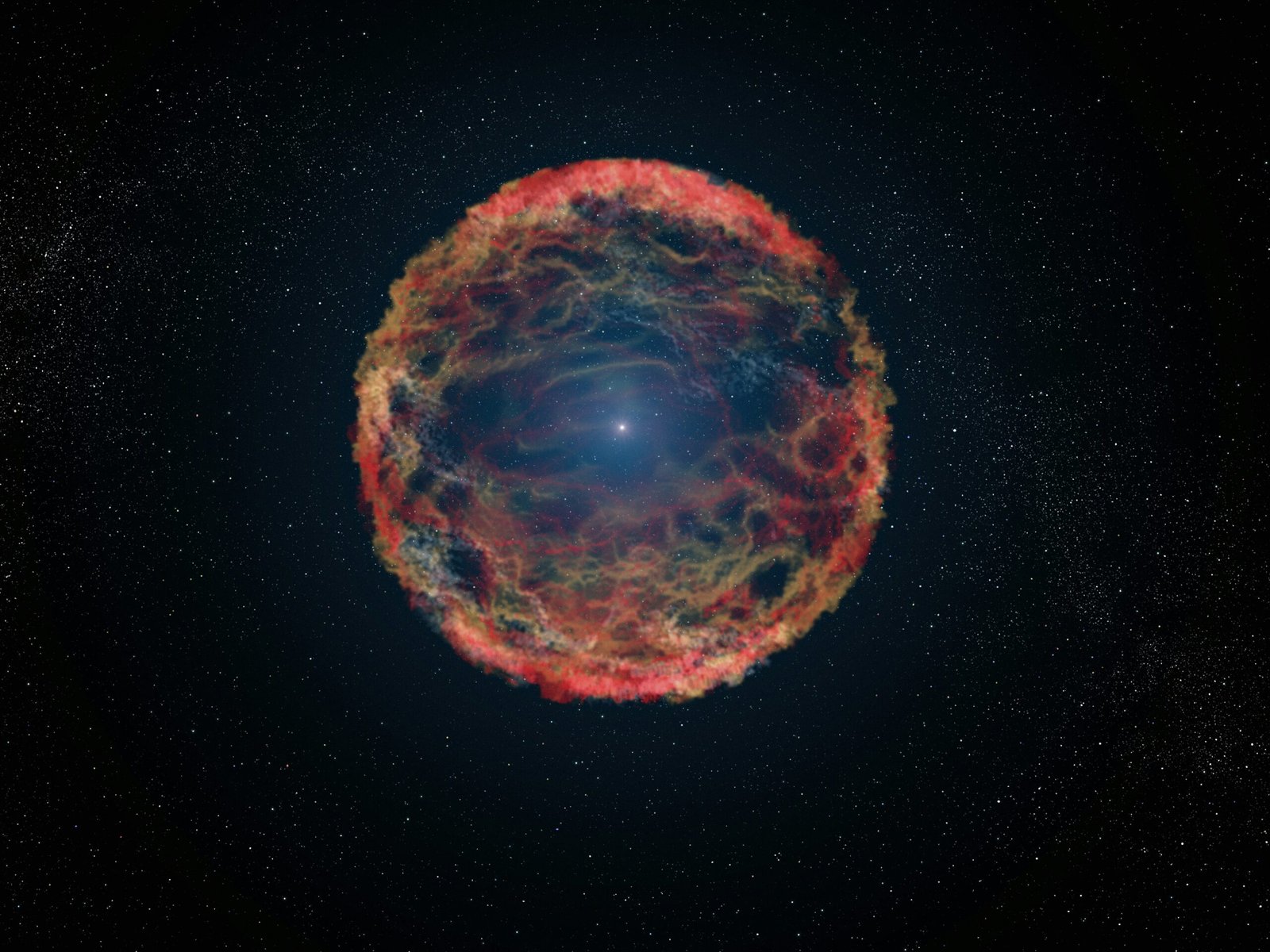
The cosmos operates as a theater of extremes, where stellar birth and death unfold in spectacular fashion. Among the universe’s most fascinating phenomena are “cannibal” stars—binary systems where one stellar companion literally devours another in a gravitational dance that can culminate in explosions visible from Earth during daylight hours. These cannibalistic interactions don’t just reshape individual star systems; they fundamentally alter galactic architecture and trigger some of the most powerful events in the known universe.
Understanding Stellar Cannibalism
Binary star systems form the foundation of stellar cannibalism, where two stars orbit each other in gravitational lockstep. The most dramatic scenarios involve a white dwarf—an ultra-dense stellar corpse roughly the size of Earth but containing the mass of our Sun—systematically stripping material from its companion star. This mass transfer creates an accretion disk of superheated matter spiraling into the white dwarf, gradually pushing it toward a critical mass threshold. The ZTF J1813+4251 system exemplifies this extreme behavior, with its two stellar components completing their orbital dance in just 51 minutes—the shortest known orbital period for any binary system.
Cosmic Rejuvenation Through Destruction
Paradoxically, stellar cannibalism can extend a star’s lifespan while simultaneously sealing its fate. In the chaotic environment surrounding Sagittarius A*, our galaxy’s supermassive black hole, researchers have identified stars that maintain surprisingly youthful characteristics despite their advanced age. These stellar vampires achieve rejuvenation by colliding with and absorbing nearby companions, incorporating fresh hydrogen fuel that reignites nuclear fusion in their cores. This process creates what astronomers call “blue stragglers”—stars that appear younger and more massive than their stellar neighborhood would suggest, defying conventional stellar evolution models.
The Supernova Endgame
The cannibalistic feast cannot continue indefinitely. When a white dwarf accumulates enough material to approach the Chandrasekhar limit—approximately 1.4 times the mass of our Sun—it triggers a Type Ia supernova, one of the most energetic explosions in the universe. These stellar detonations can briefly outshine entire galaxies and remain visible across cosmic distances. Recent observations by the Hubble Space Telescope have captured the aftermath of such explosions, revealing how these cataclysmic events seed the universe with heavy elements essential for planet formation and, ultimately, life itself.
“Astronomers have discovered the secret of a strange star system that has baffled them for years, finding it contains a dead star about to erupt after overfeeding on a stellar companion,” notes a recent study.
Key Takeaways
- Binary systems with ultra-short orbital periods represent the most extreme examples of stellar cannibalism, with some completing orbits in under an hour.
- Mass transfer from companion stars can temporarily rejuvenate aging stellar remnants, creating anomalously young-appearing objects.
- Type Ia supernovae resulting from stellar cannibalism serve as cosmic foundries, distributing elements crucial for galactic chemical evolution.
Conclusion
Stellar cannibalism reveals the universe’s capacity for both creation and destruction within the same cosmic process. These binary interactions demonstrate how gravitational forces can drive stellar evolution toward explosive endpoints that paradoxically enable future star formation. As astronomical surveys continue identifying more of these systems—particularly those approaching supernova conditions—we gain deeper insights into the mechanisms that have shaped our galaxy’s chemical composition and structural evolution over billions of years. The study of cannibal stars ultimately illuminates how cosmic violence becomes the engine of cosmic renewal.